Uncategorized
Rooftop Solar Cost for Businesses in Gujarat: What You’ll Actually Pay in 2026
Every rooftop solar conversation with a factory owner, hotel GM or warehouse manager in Gujarat starts with the same question: “What will this cost me?” It’s the right question — but the number quoted on day one is rarely the number that matters. What matters is cost per kW installed, what’s actually included in that number, and what it becomes after GST input credit and accelerated depreciation are applied.
This guide breaks down commercial and industrial rooftop solar pricing in Gujarat for 2026 — what drives the cost, realistic ranges by system size, and the two levers (GST and depreciation) that change your real outlay more than most quotes let on.
What Actually Drives Your Rooftop Solar Cost
Per-kW pricing on a rooftop system isn’t one number — it moves with a handful of site-specific factors:
- Roof type. RCC roofs need less structural work than old metal-sheet or asbestos roofs, which often require reinforcement or a full sheet transition before panels go up.
- System size. Cost per kW falls as system size rises — a 25 kW system and a 1 MW rooftop plant do not price the same per kW, because fixed costs (design, cabling runs, protection equipment) spread across more capacity.
- Module and inverter choice. TOPCon and bifacial modules cost more per watt than standard mono-PERC; string vs. central inverter choice also shifts the number.
- Cable runs and shading layout. A roof with multiple sheds, shadow-throwing structures, or long cable runs to the inverter room costs more to wire correctly than a single clear span.
- ALMM compliance. From 1 June 2026, MNRE’s ALMM (Approved List of Models and Manufacturers) List-II mandate applies to all grid-connected commercial and industrial projects, including net-metered rooftop. This restricts sourcing to empanelled Indian manufacturers, which is a factor in current pricing.
Typical Cost Ranges for Commercial & Industrial Rooftop Solar (2026)
Based on current industry-wide pricing patterns for turnkey C&I rooftop installations in India, this is the range you should expect to see on serious quotes:
| System Size | Typical Turnkey Cost Range* |
|---|---|
| 25 kW | ₹10–14 lakh |
| 100 kW | ₹35–50 lakh |
| 500 kW | ₹1.6–2.2 crore |
| 1 MW (rooftop) | ₹3.2–4.2 crore |
*Indicative 2026 market ranges based on general industry pricing patterns for turnkey C&I rooftop plants (roughly ₹35,000–45,000 per kW as a working benchmark). These are not a Deon quote — actual pricing depends on your roof type, structural condition, module choice, and site layout. Request a site assessment for a number specific to your building.
What a Turnkey Quote Should Include
A clean EPC quote should cover:
- Modules, inverter(s) and mounting structure
- DC and AC cabling, protection equipment (ACDB/DCDB), earthing
- Structural design and, where needed, roof reinforcement
- DISCOM liaison, GEDA registration and CEIG coordination
- Net meter application support
- Commissioning and first-year O&M/warranty support
Watch for what’s often excluded but assumed: roof strengthening on older sheds, distribution-transformer augmentation charges if your area’s cumulative solar load is near its cap, and cable runs beyond a standard length. Ask your EPC to itemise these rather than bundle them into a vague “installation” line.
The Two Numbers That Change Your Real Cost
The sticker price isn’t your real cost. Two things bring it down materially for a GST-registered business.
GST. Following the GST Council’s rate rationalisation effective 22 September 2025, solar power generating systems supplied as a composite package (panels, inverter, mounting and installation billed together) attract 5% GST, down from the earlier 12%. As a GST-registered business, you can claim full Input Tax Credit on this under Section 16 of the CGST Act — confirm the exact rate and contract structuring with your CA, since GST treatment of individual components (versus a bundled composite supply) can differ, and rate rules are revised periodically.
Accelerated depreciation. Under Section 32 of the Income Tax Act, solar power generating equipment qualifies for 40% depreciation on the Written Down Value (WDV) method in the year of commissioning — well above the 15% standard rate for general plant and machinery. If the plant is used for less than 180 days in that financial year, only half the rate (20%) applies for that year, so commissioning timing matters. This is a genuine and well-established tax benefit, but the actual rupee saving depends on your tax slab and profitability — talk to your CA before building it into your budget.
Figures above are illustrative, not financial or tax advice. Confirm current GST and depreciation treatment with your chartered accountant before finalising a purchase decision.
What About Payback?
Payback period is the number every business owner wants collapsed into a single figure, and the honest answer is that it’s a range, not a point. For commercial and industrial rooftop solar in India, a typical payback range is roughly 3–6 years, depending heavily on your per-unit electricity tariff, how much of your daytime load the plant covers, and financing structure (CAPEX vs. OPEX). A site with a high commercial/industrial tariff and strong daytime consumption will land toward the shorter end; a site with lower tariffs or partial daytime usage will land toward the longer end.
This is illustrative, not financial advice. Actual payback depends on your tariff, consumption profile, site conditions and financing.
Why Gujarat-Specific Rules Matter for Your Cost
Two Gujarat-specific factors can move your final number and timeline:
- Distribution transformer capacity caps. DISCOMs assess cumulative solar load against local transformer capacity before approving your connection; if your area is near its cap, augmentation charges may apply.
- CEIG and net-metering approvals. Gujarat’s net metering (via GEDA and your DISCOM — UGVCL, DGVCL, PGVCL or MGVCL) is available up to 1 MW, capped at your sanctioned load, and CEIG clearance is required above the state-notified threshold. Getting this sequence right the first time avoids delay costs. (We cover this process in detail in a separate guide.)
How to Get an Accurate Number for Your Site
General ranges are useful for budgeting, not for signing a contract. The number that matters is the one built from your actual roof condition, load profile and electricity bill. Send us your last bill and roof details, and we’ll come back with an itemised, site-specific estimate — not a generic rate card.
FAQ
What is the average cost of a 100 kW solar system in Gujarat?
Industry-wide 2026 pricing for a turnkey 100 kW C&I rooftop system in India typically falls in the ₹35–50 lakh range, depending on roof type, module choice and site conditions. This is indicative, not a quote.
Does GST apply to commercial rooftop solar in Gujarat?
Yes. Following the GST Council’s rate change effective 22 September 2025, a composite solar power generating system supply generally attracts 5% GST, with full Input Tax Credit available to GST-registered businesses. Confirm current treatment with your CA.
Can I claim full depreciation the same year I commission my solar plant?
You can claim 40% depreciation on the Written Down Value under Section 32 of the Income Tax Act in the commissioning year — but only the full 40% if the plant is in use for 180 days or more that financial year; otherwise the rate halves to 20% for that year. Confirm with your CA.
Is ground-mount solar cheaper than rooftop for the same capacity?
Ground-mount typically has lower per-kW civil and mounting costs at scale, but requires available land and land-use approvals. Rooftop makes use of otherwise idle space but can carry structural costs on older roofs. The right choice depends on your site — this isn’t a one-size answer.
How long does it take to actually pay back a rooftop solar investment?
Payback is typically in the 3–6 year range for C&I rooftop solar in India, depending on your tariff, load profile and financing model. It is illustrative and not a guarantee — request a site-specific estimate.
Related Insights
uncategorized
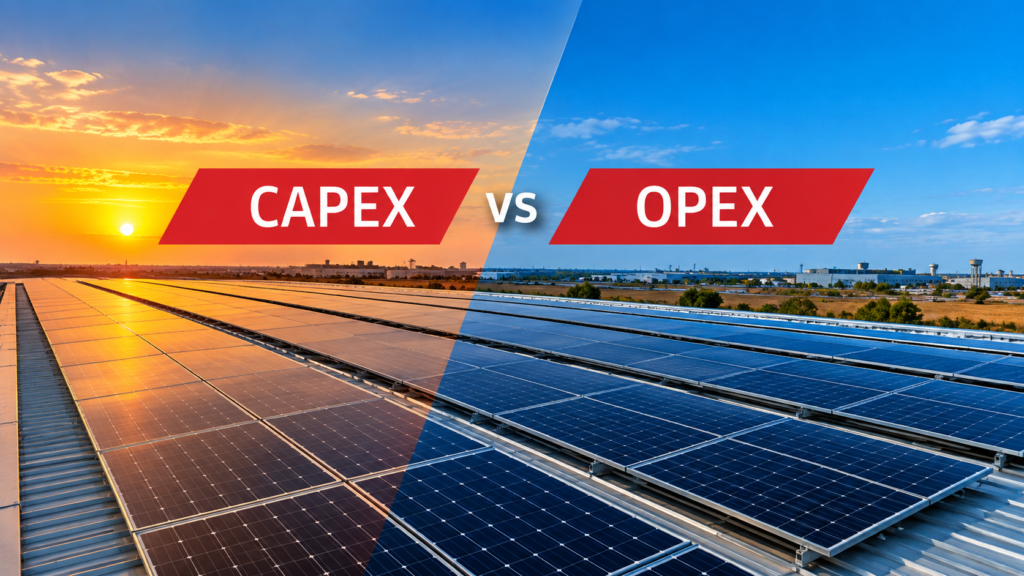
CAPEX vs OPEX Solar: Which Financing Model Fits Your Business?
Almost every commercial or industrial solar decision eventually reduces to one question that has nothing to…